

History of the manor
Discover the history of Loikansaaari
The history of Loikansaaari Manor stretches back centuries, from peasant settlement during the time of the manor house to today's vibrant countryside. The island has seen wars, generations, changes and survival – and still carries with it the stories that have shaped Loikansaaari into what it is today.
Loikansaari - ancient peasant land
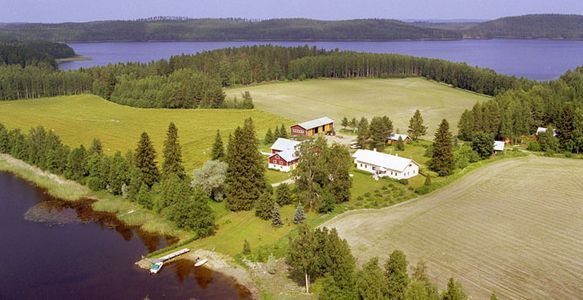
The Loikansaari farm is one of the oldest inhabited and cultivated places in the history of Säämingi. There has been a permanent settlement on the farm even before the construction of Olavinlinna began in 1475. The island already offered security and good conditions for natural farming in ancient times, with its good fishing waters and waterfalls. Old residents of the farm have included the prosperous Uskisten family and the leader of the Pien-Savo flag unit Ambrosius Heikinpoika, as well as the goldsmiths Henrik and Erik Kusell. An old farming map of the farm drawn for taxation purposes from 1643 shows that there were two separate houses, fields and forest areas on the site of the current buildings. Juho Loikkanen and Erkki Nyrhinen lived in these houses and cultivated the fields until 1651, when the peasant farms were transferred to the ownership of the nobility. It is believed that Loikansaari was named after its old permanent residents, the Loikkans.
The birth of Lagerholm Manor and the time of the Pistolekors
In 1650, Queen Christina of Sweden granted Loikansaari to the cavalry master Erik Jönsson Lagercrantz as a salary loan for his services in the Thirty Years' War. The old permanent residents were allowed to leave when the ennobled war hero began to build a manor house that he named Lagerholm, befitting his rank. The matter was confirmed on 13 January 1651 at the Sääming Winter Parliament and Lagercrantz received permission from the governor on 16 July 1651. At this stage, the manor had included 3 ¾ manta areas of land, which today corresponds to an area of approximately 2,650 hectares. However, Erik Lagercrantz did not have long to be the master, as the cavalry squadron he had assembled was completely destroyed in the Polish War in 1656 and Lagerholm was left without a master.
Barbara von Strasenburg, the widow of the manor's founder, married Major Göran Pistolekors the Younger in 1658. This marked the beginning of the Pistelokors noble family's 240-year, seven-generation ownership of Loikansaaari Manor. They managed to keep the estate in the family through difficult years of famine and war. It should be noted that the estate's location, right on the border between Sweden and Russia from 1743, posed its own challenges for the management of the estate. At that time, the Loikansaaari area had passed to Russia after the Peace of Turku.
Loikansaaari Manor is said to have had a very advanced building culture as early as the late 17th century. Examples of this include the buildings' chimneys, glass windows and the painting of the outside of the house with red clay. These were still very rare at the time, as it was still the time of smokestacks.
The Pistolekors, especially Göran and his brother Abraham, have been linked to many crimes, and it is said that they tarnished the reputation of the entire family with their actions. The Pistolekors were masters of reasoning and were tough to take to court. They often fled the clutches of the law to Russia, where many of them served as officers in the Tsarist army, as they were from military families. Both Göran and his next master, his son Adam Pistolekors, lived in the Aholahti manor and also managed their Loikansaaari estates from there. The year 1684 was fateful, because the Lagerholm manor was completely destroyed with all its buildings, of which there were 16, in a fire started by lightning. Another major setback was in 1713, when the manor was completely plundered by the Russians. The master, Adam, was taken prisoner from Aholahti and transported to Russia, where he died in 1718.
The permanent owner of the manor, Lagerholm, was Otto Fabian Pistolekors from 1725 to 1750, during which time the manor became a manor house. The manor house was exempt from taxes in exchange for cavalry service in the Crown's army. The oldest parts of the current main building are considered to have been standing when Otto became the owner. The next owner in direct descent was the customs officer Berndt Adam Pistolekors, and after him Berndt Adolf Pistolekors. After him, the farm was managed by his daughter Anna Elisabeth. At that time in 1897, the farm had 86 cattle units, the harvest was 550 hectoliters including potatoes, grain and root vegetables. The harvest was the fifth largest in the Säämingi region. The registered population of Säteri was 50 people.
The Pistolekors era ended at Loikansaaari Manor in 1898, when Berndt Adolf's daughter's son Selim Lagus gave up the estate. The following decades saw the estate deteriorate rapidly, as owners changed frequently, lands were sold off and everyone took away what they considered valuable. The changing owners during this time included Hanno Tiainen, the Hirvensalo family, consul Eugen Wolff and the Kiansteenin, and the Laamasten family.
People from Häme in Loikansaari
The Hämäläinen family's ownership of the Loikansaaari manor began in 1925, when the current owner's grandfather Antti Hämäläinen (b.1901 d.1991) bought the farm from Konsta Laamanen. The farm's name Lagerholm was removed from the land register in 1930 and the farm began to be called Loikansaaari. In the time of Antti and Aili, traditional agriculture and forestry were practiced in Loikansaaari and people lived largely on a subsistence basis. The house had a permanent workforce of four people and during peak hours, more people were needed for haymaking. Most of the work was done by hand, but in the fields, horse-drawn agricultural equipment was used to help.
The house received a telephone in 1937 and the mail was collected from the Aholahti railway station, because there was no road to the island yet. The radio was listened to and during the war the islanders gathered in the Loikansaari hut to hear news from the front. There was a pier in Vanhanrannanlahti, from which a ship called Sirkka sailed to the city on weekdays. Otherwise, they traveled by motorboat from the shore of the Kotilahti bay, for example, the farm's milk was taken to the city by boat. The year 1953 changed the direction of development. The Loikansaari manor received electricity and the first tractor was purchased. Soon the farm's first car, a Skoda, was also purchased and stored in a garage in Apajaniemi. The spring and autumn junk seasons were difficult for traveling to the mainland.
Second-generation ownership began in Loikansaari in 1956, first as joint ownership by Heikki and Matti Hämäläinen, and in 1961 the farm was transferred to Heikki's full ownership. During Meer and Heikki's time, the farm had, in addition to cows, first a pig farm and then a chicken farm, but in 1978, animal husbandry was completely abandoned. The farm had small-scale horticulture, but the main focus in the fields was on sugar beet and potato cultivation. Contract farming of sugar beet lasted continuously for a total of 34 years, starting in 1966 and ending in the autumn of 2000. During Meer and Heikki's time, extensive field renovation work was carried out in Loikansaari, old pastures were afforested, and the farm's production focus changed from animal husbandry to farming and rural tourism. During their time, machines were put to work in the fields, but employing foreign workers became expensive.
The road connection to the mainland was completed when the Loikansaari road was completed in the autumn of 1964. This also made it possible to start rural tourism a decade later. At first, Meeri and Heikki rented one cottage and a barn in the yard, but when demand began to increase, four more rental cottages were built in 1977. From the beginning, the clientele of the rental cottages has been international.
The change of generation to the 3rd generation took place in 1994 when Antti Juhana Hämäläinen stepped into the owner's shoes. At first, the fields continued to be cultivated with sugar beet, but for reasons of profitability, this was changed to caraway cultivation in 2000. Antti did tractor contracting work throughout the initial ownership until 2006. In 2004, tourism and forestry had become the main production direction of the farm. New over year beach villas were completed for rental use on land acquired next to the Loikansaari main farm. The previous holiday cottages were renovated by the summer of 2000.
In 2024, Loikansaaari Manor celebrated its centenary. Rural tourism had been practiced continuously for 50 years, of which 30 years by the current owner.